Bereishis ›Vayechi (Genesis 47:28-50:26)
Mama's Tears
January 11, 2006 · Rabbi Yerachmiel Seplowitz
I studied for several years in Israel. Shortly before our first child was born, almost 26 years ago, we left Israel and returned to the U.S. For twenty years, Israel was a memory from my past, and a some-day hope for my future. Finally, about five years ago, when my daughter was studying there, I had cause to go back for a short visit.
It was a stroll down memory lane. I visited my old Yeshiva, and saw some of my old teachers. (One teacher, sitting in his old seat that I remembered from two decades previously, eyed me curiously. I could see that he knew that I looked familiar, but that he couldn’t place the face. “Sholom Aleichem, Rebbe. I’m Yerachmiel Seplowitz.” His face brightened. “Oh, you look the same – just a little older.” “Yes,” I said to my beloved teacher, whose beard had gone from black to white. “So does the Rebbe!” [I always addressed him in third person.])
Jerusalem was very much the same, yet very different. I looked up some of my old friends and went to some of Jerusalem’s holy sites. I also went to a few cemeteries.
Judaism does not, of course, believe in worshiping the dead, G-d forbid. Rather, we go to the graves of the righteous and pray to G-d, with the hope that the merits of those pious people will cause G-d to respond favorably to our prayers. Also, we request that the righteous people whose souls live on in Heaven will intercede with G-d on our behalf.
I brought along our “Mi Sheberach” list, a list of sick people for whom we pray in my synagogue every Shabbos. Why not pray for them in some of these holy places?
My daughter and I got off the bus and approached the building. I was aware of the new architecture, so I wasn’t surprised by the Tomb’s new appearance. However, I wasn’t prepared for what met me inside.
I walked into the smaller, famous building. There I saw the large monument, with a large velvet cover draped over it. People all over the room were praying, the men on one side and the women on the other. I took leave of my daughter and joined the men. I reached into my pocket and took out my list of names. I reached into another pocket and took out a Book of Psalms. And then it happened.
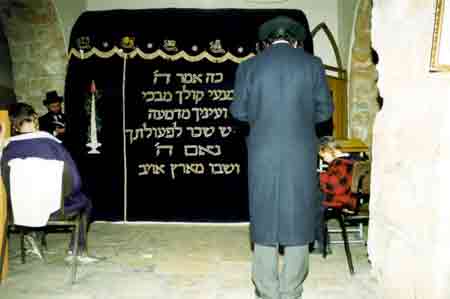
The floodgates opened up. My eyes filled with tears and I started crying uncontrollably. I couldn’t stop. I was standing at the grave of Mother Rachel and I couldn’t stop crying.
Now, I am not what you would call a particularly emotional person. What was it that caused me to react in that way? There was nothing in my particular prayers that would normally have led me to cry. So what was it?
It was Rachel.
-————————————
Jacob spent the last seventeen years of his life in Egypt. He did not want to spend his “afterlife” in Egypt. His dying day was approaching, and he wanted to make sure that his sons would do the right thing. He made Joseph promise to return Jacob’s body to the land of Canaan for burial. He wanted to be buried in the Cave of Machpela, along with Adam & Eve, Abraham & Sarah, Isaac & Rebecca, and Jacob’s own first wife, Leah.
However, there was a concern. Where was Joseph’s mother, Rachel? Why wasn’t there a place for her in the family plot? Why had Jacob buried her by the side of the road right where she died, giving birth to Benjamin? Why didn’t Joseph’s father give Joseph’s mother a decent burial? And now, Jacob expects Joseph to go to the trouble of transporting his father all the way back to Canaan?!!
Jacob suspected that Joseph was plagued by these questions. Therefore, he felt that his son was entitled to an explanation:
“But, as for me, when I came from Paddan, Rachel died on me in the land of Canaan, where there was still a stretch of land to go to Ephrat; and I buried her there on the road to Ephrat which is Bethlehem.” (Genesis, 48:7)
Our Sages explain that there was a specific reason why Jacob left Rachel right there, by the roadside. A protective mother never goes to where she can’t keep a watchful eye open for her children. Jacob left Rachel in that spot because he knew prophetically that that is where she needed to be.
Centuries later, after the destruction of the First Temple, the Babylonians led our people away into captivity. The souls of Moses, Abraham, and others pleaded with G-d, but to no avail. As the Babylonians led their captives past the Tomb of Mother Rachel, she cried to G-d for mercy:
A voice is heard on high, wailing, bitter weeping, Rachel weeps for her children; she refuses to be consoled for her children, for they are gone. G-d says, “Restrain your voice from weeping, and your eyes from tears… they will return from the enemy’s land… there is hope for your future… your children will return to their border.” (Jeremiah, 31:14-16)
The Talmud (Berachos 32b) tells us that at the time of the Destruction of the Temple all the gates to Heaven were sealed, with one exception. The Gates of Tears always remain open. Rachel’s tears opened those gates. There are no tears more potent than those of a mother.
For as long as our People have had access to Rachel’s Tomb, it has been a place that Jews go to pour out their hearts to G-d, with Mother Rachel joining in with her tears. It is told that when Rabbi Chaim Shmuelevitz used to pray at Rachel’s Tomb, he had a special request for our Matriarch. He understood that G-d responds to Rachel’s tears. He wanted to make sure that Rachel’s tears, a key to G-d’s compassion, would continue to flow.
“Mama Rochel,” he would say in Yiddish. “G-d says, ‘Restrain your voice from weeping, and your eyes from tears.’ But your son Chaim says, ‘Cry for us, Mama Rochel! Keep crying to G-d for us!”
And so, Mama Rochel continues to cry for us. She cried to G-d as her children were led to Babylonia. She cried for us when the Romans destroyed the Second Temple, not far from her tomb. She cried when her children went up the smokestacks of Auschwitz. And she cries when our enemies, living all around her sacred tomb, plot their unholy plans to blow her children to pieces on busses and in Pizza shops. Mama Rochel cries, and G-d will listen. He promised he would. “… There is hope for your future… your children will return to their border.”
-––––––––––
Can you now understand my tears as I prayed at Rachel’s Tomb? I couldn’t help it. Mama Rochel was crying; we cried together.
It was time to go. I must confess that I felt a bit self-conscious. I dried my eyes and composed myself. I left the men’s section and went out to rejoin my daughter.
She looked at me and handed me a tissue. She understood.
Have a great Shabbos. Rabbi Yerachmiel Seplowitz
© 2006 Rabbi Yerachmiel Seplowitz. You may reprint this message for non-commercial use with attribution to torahtalk.org.